Learning by making things
Intro
When trying to learn something new often the hardest problem to solve is finding the right questions to ask. Here I sit wanting to create a simple web server in TypeScript, in order to have some experience with the language, and I'm stumbling at the first hurdle—where do I start?
Having committed to using Deno, as it supports TypeScript and wanting to use it since it was first announced, I'm faced with the question of which libraries to use. Do I use a TypeScript first library? An existing established JavaScript library and pray for straightforward interoperability? I could roll my own but now I'm solving an already well solved problem and not starting at the one to hand. Instead of equivovating—let's jump in!
The options
First up I begin with searching for "deno web server" and find that I have the following URL in my history as suggested by Firefox:

Well that's a good a place to start as any (you can see my approach is
very scientific). In their example they use a library called oak
which appears to have the .ts TypeScript extension so that's a few
boxes checked already. Let's see how that goes in practice.
Firstly we grab their stock "Hello, World!" example, stick it in a
file and see what deno does.
$ pbpaste > server.ts
$ deno run --allow-net server.ts
Warning Implicitly using latest version (v12.6.1) for https://deno.land/x/oak/mod.ts

# In another terminal ...
$ curl http://localhost:8000/
Hello world!
Excellent, this looks like a good place to start! It seems sometimes the best place to start is with your browser history.
Back to basics
Ordinarily I would use trusty ol' Emacs for writing code but in this
instance I'm trying learn new things so it's finally time to use
Code (what a name!) in anger. Downloading and getting it running
is fine and Deno also has docs specifically for Code. But! It makes the
classic doc blunder of using one name in the docs, vscode_deno, and
then not using that same name in the extension itself:
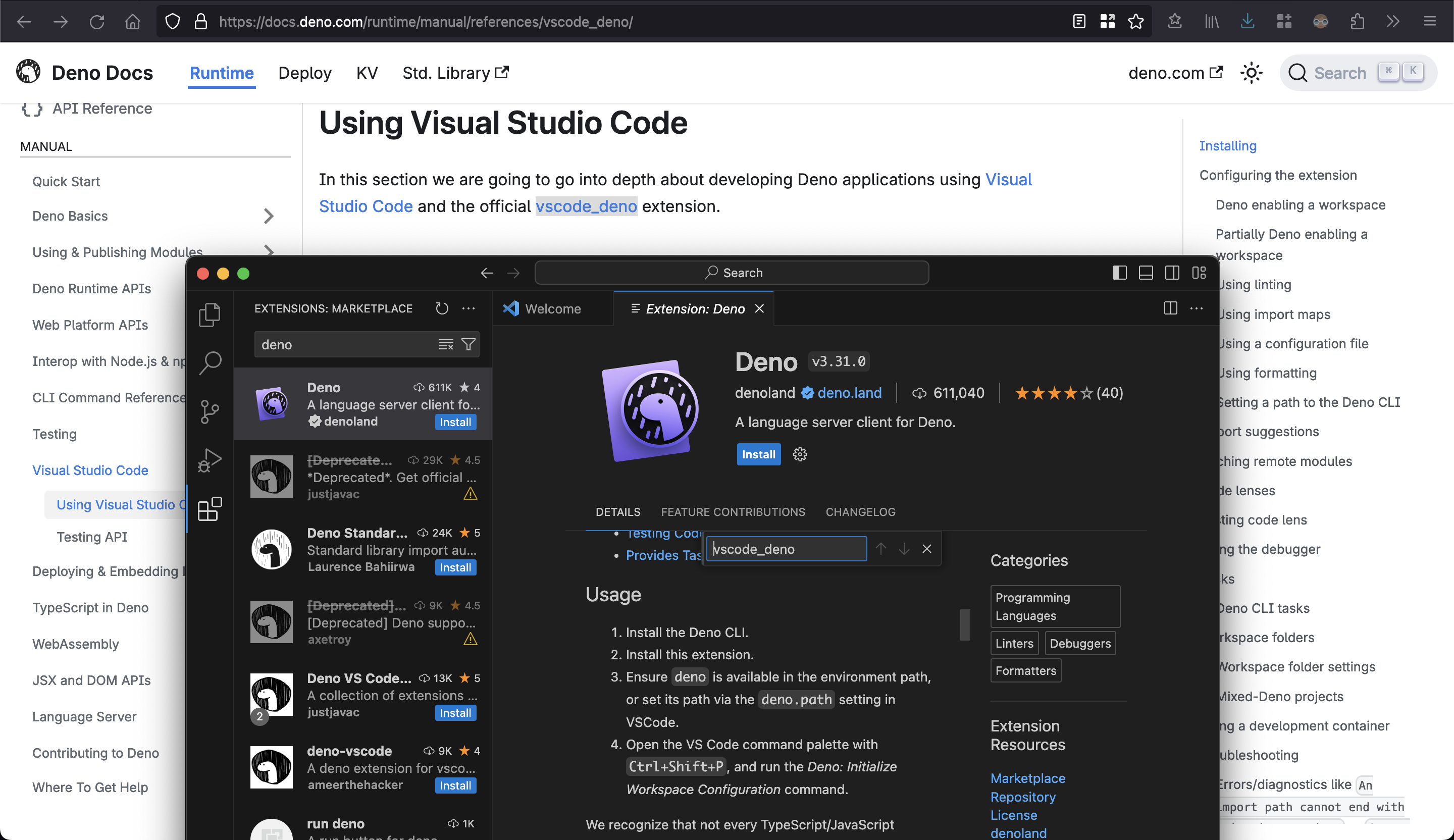
Now the first thing I must do is "enable a workspace" which is not a concept I currently possess (although I can likely muddle through with similar concepts from other editors/runtimes/etc) ... ok following the instructions produces an error about a lack of workspace. A few steps back are going to be necessary here.
An educated guess suggests this is to do with Code, rather than Deno, so let's try those docs. Nothing in the top level of the docs ... ok, the concept isn't essential or well advertised. In that case let's just try stuff in Code ... opening a folder instead of a file has allowed the relevant magic to happen. The squiggly red has now disappeared and the coding can begin in earnest!
Actual requirements
What's really needed is something that fetches the most recent games from the various Dungeon Crawl servers. Then something else that figures out which are the winning games. Then a final piece to expose that information. Sounds like a job for a library! Or at least a dedicated module as I believe they're called in JavaScript-land. Having some experience in this area I'm ready to dive right in, to writing TypeScript, which is basically JavaScript right?
Firstly we need some data to work with so let's what we have to work with. The logfiles for the crawl servers are handily defined already so we put together a URL for a nearby server for the latest version and see what it looks like:
$ curl -I https://webzook.net/soup/0.30/logfile
HTTP/1.1 200 OK
Date: Thu, 04 Jan 2024 08:42:05 GMT
Server: Apache/2.4.57 (Unix) OpenSSL/3.0.2
Last-Modified: Thu, 04 Jan 2024 08:07:29 GMT
ETag: "7d7c1f-60e1a3916919e"
Accept-Ranges: bytes
Content-Length: 8223775
Ok so that's about 8MB which isn't something we want to fetch on a regular basis. But let's fetch it once and have a look at the data!
§ wget -O webzook-0.30.logfile https://webzook.net/soup/0.30/logfile
...
2024-01-04 15:50:31 (662 KB/s) - ‘webzook-0.30.logfile’ saved [8223775/8223775]
§ tail -1 webzook-0.30.logfile
v=0.30-b1:vlong=0.30-b1-7-gcb88a99046:lv=0.1:vsavrv=Git::0.30-b1-7-gcb88a99046:vsav=34.253:tiles=1:name=FDmntl:race=Spriggan:cls=Brigand:char=SpBr:xl=2:sk=Stealth:sklev=6:title=Sneak:place=D::2:br=D:lvl=2:absdepth=2:hp=0:mhp=14:mmhp=14:mp=3:mmp=3:bmmp=3:str=7:int=12:dex=16:ac=3:ev=16:sh=0:start=20240003183332S:dur=1730:turn=898:aut=6576:kills=23:status=lethally poisoned (0 -> -13):gold=44:goldfound=44:goldspent=0:scrollsused=0:potionsused=0:sc=25:ktyp=pois:killer=a goblin:dam=3:sdam=3:tdam=3:end=20240004080729S:seed=5894012356088655548:tmsg=succumbed to a goblin's poison
Super! Some colon–delimited key=value pairs, that should be easy
enough to work all things being equal. Now does Code provide a REPL
for poking about with ... it seems like not?. At a glance it
suggests TypeScript REPLs aren't commonly used, so let's hope there's
a JavaScript REPL or we'll be running deno from a terminal.
It seems the line–based paradigm is out and live coding is in, cool, that works too. It looks like JavaScript REPL is the extension of choice and I'm happy to go with that. It works and is nice but, as my first experience of writing code with Code (that name!) shows that the editor is a little too eager to flag every little issue the very moment it occurs. I believe that can be configured ... bumping up some delays makes it seem less aggressive but only marginally. At any rate it's working nicely and I can easily build a map that shows what happened in the game.
const logline = `v=0.30-b1:vlong=0.30-b1-7-gcb88a99046:lv=0.1:vsavrv=Git::0.30-b1-7-gcb88a99046:vsav=34.253:tiles=1:name=FDmntl:race=Spriggan:cls=Brigand:char=SpBr:xl=2:sk=Stealth:sklev=6:title=Sneak:place=D::2:br=D:lvl=2:absdepth=2:hp=0:mhp=14:mmhp=14:mp=3:mmp=3:bmmp=3:str=7:int=12:dex=16:ac=3:ev=16:sh=0:start=20240003183332S:dur=1730:turn=898:aut=6576:kills=23:status=lethally poisoned (0 -> -13):gold=44:goldfound=44:goldspent=0:scrollsused=0:potionsused=0:sc=25:ktyp=pois:killer=a goblin:dam=3:sdam=3:tdam=3:end=20240004080729S:seed=5894012356088655548:tmsg=succumbed to a goblin's poison`;
const pairs = logline.split(/\b:\b/);
const result = pairs.reduce((acc: Object, s) => {
  const p = s.split(/\b=\b/);
  return {...acc, [p[0]]: p[1]};
}, {});

{ absdepth: '2',
  ac: '3',
  aut: '6576',
  bmmp: '3',
  br: 'D',
  char: 'SpBr',
  cls: 'Brigand',
  dam: '3',
  dex: '16',
  dur: '1730',
  end: '20240004080729S',
  ev: '16',
  goldfound: '44',
  goldspent: '0',
  hp: '0',
  int: '12',
  killer: 'a goblin',
  kills: '23',
  ktyp: 'pois',
  lv: '0.1',
  lvl: '2',
  mhp: '14',
  mmhp: '14',
  mmp: '3',
  mp: '3',
  name: 'FDmntl',
  place: 'D::2',
  potionsused: '0',
  race: 'Spriggan',
  sc: '25',
  scrollsused: '0',
  sdam: '3',
  seed: '5894012356088655548',
  sh: '0',
  sk: 'Stealth',
  sklev: '6',
  start: '20240003183332S',
  status: 'lethally poisoned (0 -> -13):gold',
  str: '7',
  tdam: '3',
  tiles: '1',
  title: 'Sneak',
  tmsg: 'succumbed to a goblin\'s poison',
  turn: '898',
  v: '0.30-b1',
  vlong: '0.30-b1-7-gcb88a99046',
  vsav: '34.253',
  vsavrv: 'Git::0.30-b1-7-gcb88a99046',
  xl: '2' }
Now we just pull out the field which shows the game ended in a
win. That field is not technically present in fact. Luckily, as I say,
I've been here before and happen to know that if the tmsg field
begins escaped with the Orb then it's a winner (these days we
have a handy API doc too!). So know we can filter for winning
games based on that info, so let's see how many winning games there
have been for 0.30 on webzook.net.
Data please
So we read from the file using a node adjacent API like io right?
Right? Only if you like deprecated libraries!
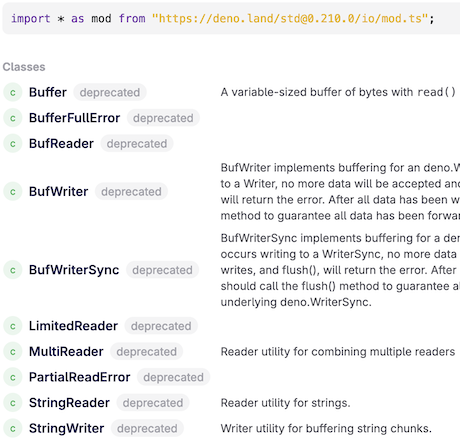
If I want to do something as innocent as read lines from a file what should I be doing?

It should be a squints suspiciously a Web Streams API‽ No. No I dont' think so. The sweet embrace of deprecation warnings it is!

Apparently not. And even if it were it seems the API is like something a 90s Java library author might have written (hey look slurping all lines at once landed in Java 8!).
Ok here I recognize I'm out of my depth and admit defeat, for now, and just pull out an elegant tool for more a civilized age:
$ perl -nE '$tot++; $wins++ if /tmsg=escaped with the Orb/ } { say sprintf "%d wins out of a total %d games which is a win percentage of %.2f", $wins, $tot, ($wins / $tot * 100)' webzook-0.30.logfile
103 wins out of a total 13485 games which is a win percentage of 0.76
That's some nice data and means we have something useful to work with (no surprise there!). And here is a good point to call it a day and think back on what was learnt.
Going foreword
Today I learnt:
- A little about Deno: it mostly just works!
- A little more about Code: how to create+open a workspace, run some TypeScript in situ, configuring some things
- That the DCSS logfile data is pleasantly stable (little to no change in over 10 years!)
- There are too many static site blogging options (and it's too boring to bother blogging about)
That's a good start! Next I want to be pulling data from a server directly and getting a feed of wins.